
Data Privacy Laws and What They Actually Mean for Your Nigerian Small Business
- Ononkwa Egan
- Mar 31
- 16 min read


Let's start with a scenario that's more common than most Nigerian business owners would like to admit.
You built a customer database over three years. Names, phone numbers, email addresses, purchase histories, and BVN details for those who paid through certain channels. It lives in a spreadsheet on your laptop, backed up, if you're organised, to Google Drive. Your staff can access it. Maybe a freelancer you hired to run a marketing campaign had access to it at some point. You're not entirely sure what happened to that access after the contract ended. You've never had a privacy policy on your website because, honestly, you weren't sure anyone read those things. And nobody has ever complained.
Until now, that was probably fine. Not because it was right, but because enforcement was light, awareness was low, and most customers didn't know they had rights worth asserting.
That era is ending. The reality is that data privacy laws for Nigerian small businesses are no longer optional; they are shaping how businesses collect, store, and use customer data.
The Nigeria Data Protection Act 2023 isn't a proposal or a guideline. It's law, enforced by the Nigeria Data Protection Commission, with penalties that can reach 2% of your annual revenue or between ₦2 million and ₦10 million, whichever is higher. For a business generating ₦50 million annually, 2% is ₦1 million. For a business generating ₦500 million, that's ₦10 million. These are not theoretical numbers; they are the actual financial exposure your business faces if you're operating without compliance.
But here's the thing that the compliance-focused framing of data privacy tends to miss: this isn't just about avoiding penalties. It's about something more fundamental, whether your customers can trust you with their information, and whether that trust becomes a genuine competitive advantage in a market where most businesses haven't thought seriously about it yet.
Let's go through all of it properly.
Data Privacy Laws for Nigerian Small Businesses: What the NDPA Actually Means

Nigeria has had data protection rules since 2019, when the Nigeria Data Protection Regulation was issued. The NDPR was a meaningful first step; it established the basic framework and signalled that Nigeria was taking data protection seriously. But it had significant limitations. It was a regulation rather than primary legislation, which gave it less legal weight. Enforcement was inconsistent. Many businesses ignored it with no real consequences.
The NDPA 2023 is different in ways that matter.
Firstly, it is primary legislation, an Act of the National Assembly, which means it has significantly more legal force than the NDPR ever did. Secondly, it established the Nigeria Data Protection Commission as a dedicated, independent regulatory body with a clear mandate to enforce the law. Thirdly, the penalties are substantial enough, actually, to change behaviour.
The data that falls under the NDPA's protection includes any information that can be used to identify a person, such as name, phone number, email address, physical address, bank account details, BVN, NIN, IP address, location data, biometric data, and health information. If your business collects any of this, and virtually every business does, the NDPA applies to you.
This is worth sitting with for a moment. Think about the touchpoints through which a typical Nigerian SME collects personal data. A customer fills in a contact form on your website. Someone registers for your newsletter. A client provides their bank details for payment. An employee fills in an onboarding form. A delivery customer gives their address. Someone enquires via WhatsApp, and you save their number. All of this is personal data collection, and all of it is now regulated.
The businesses that understand this early and treat every data collection touchpoint as something that requires thought and proper management will be significantly better positioned than those that continue to treat customer data as an unmanaged resource.
The Seven Principles: Understanding the Philosophy Before the Rules
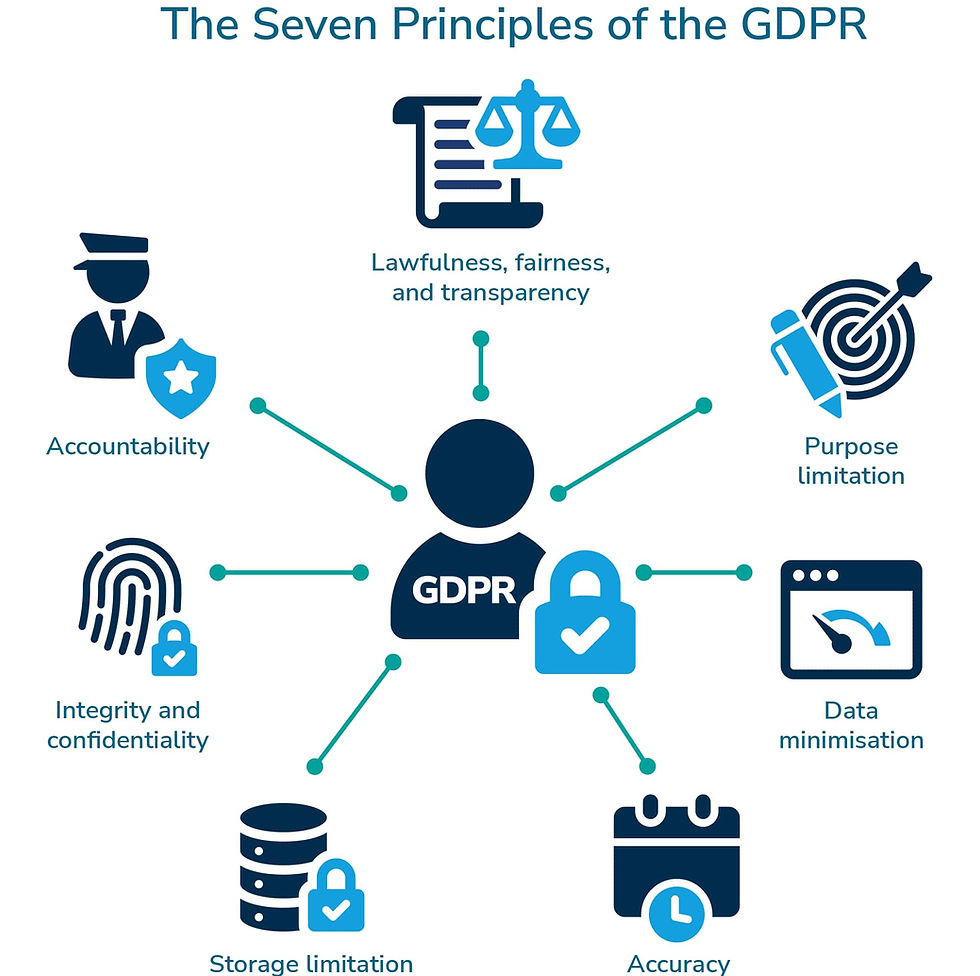
The NDPA, like most modern data protection laws, is built on principles rather than prescriptive rules. This is deliberate; it's impossible to write specific rules that cover every possible data processing scenario. Instead, the law establishes a philosophical framework and expects businesses to apply it to their specific context.
Understanding these principles isn't just a compliance exercise. It's actually a useful framework for thinking about how your business should handle information.
2.1 Lawfulness: You need a reason
Before you collect any personal data, you need a lawful basis for doing so. The most common bases are consent, the person has agreed, and contract, you need the data to fulfil an agreement with the person. There are others: legal obligation, vital interests, public task, and legitimate interests.
The practical implication is that you can't just collect data because it might be useful someday. Every data collection needs a justification. Why are you collecting this person's date of birth? If it's because you need it to verify age eligibility for a product, that's a lawful basis. If it's because it seemed like useful information to have, that's not a lawful basis.
This enforces a discipline that many Nigerian businesses have not adopted in their data collection practices. Implementing this may ironically lead to greater operational efficiency by reducing the collection of unnecessary data.
.2.2 Fairness and transparency: No surprises
People whose data you collect should understand how it's being used. There should be no hidden processing, no unexpected uses, no situations where someone hands over their phone number for one purpose and finds it being used for something completely different.
This principle is why privacy policies exist, not as legal boilerplate that nobody reads, but as a genuine communication to customers about what you do with their information. A good privacy policy is written in plain language that a person without legal training can understand. It explains what you collect, why you collect it, what you do with it, who you share it with, and how long you keep it.
Most Nigerian SME websites either have no privacy policy at all or have one copied from a foreign website that doesn't actually describe what the business does. Both are problems. The first is a clear compliance gap. The second is almost worse: a privacy policy that doesn't accurately describe your data practices is potentially more misleading than having none at all.
2.3 Purpose limitation: Use data only for what you said you'd use it for
This principle is violated constantly in Nigerian business, often without any awareness that it's happening. Someone gives you their phone number to receive a delivery notification. Three months later, you're sending them promotional messages. The purpose for which they shared their number, delivery notification, didn't include marketing, and using it for marketing without their separate consent violates this principle.
Purpose limitation requires you to think about data use before you collect the data, not after. When you design a data collection form or a customer onboarding process, you need to have already decided what you'll use that data for, and you need to communicate that clearly.
This has real operational implications. It means you can't build a database of customer contact information from one business activity and then repurpose it for marketing campaigns without going back and getting consent for that specific use. It means you need to be thoughtful about what you're agreeing to when you allow a third-party service to collect data on your behalf.
There is an ingrained tendency in business, partly driven by a vague sense that more data is always better, to collect as much information as possible from every interaction. The NDPA pushes back against this directly.
Collect only the data you actually need for the purpose you've identified. If you're shipping a product to someone, you need their delivery address and phone number. You likely don't need to collect information such as their date of birth, occupation, or monthly income unless you have a specific operational reason for doing so.
This principle offers practical business advantages beyond just compliance: collecting less data reduces storage costs, minimises security risks, simplifies data management systems, and decreases liability in the event of a breach or incident. The most dangerous data breach is one involving data you collected but didn't actually need, because then you've caused harm without even receiving the benefit that the data might have provided.
2.5 Accuracy: Keep your records correct
The data you hold about people should be accurate and kept up to date. This is more operationally demanding than it sounds, because data degrades over time, people change phone numbers, move addresses, change their names, and close old email accounts.
For Nigerian businesses that have been accumulating customer databases for years without any systematic data maintenance, this principle suggests that a data audit isn't just a compliance exercise; it's also good operational hygiene. A customer database full of outdated contact information is not just a compliance problem; it's a business problem, because you're spending marketing resources reaching out to people through channels they no longer use.
Data should not be retained longer than necessary for the purpose it was collected. Once the purpose is fulfilled, the transaction is complete, the contract has ended, the customer relationship has been dormant for long enough that there's no realistic expectation of resumption, and the data should either be deleted or anonymised.
This is the principle that most businesses find operationally most challenging, because it requires having a data retention policy, an explicit set of rules about how long different categories of data are kept and what happens to them afterwards. Most Nigerian SMEs have never thought about this at all. Data accumulates indefinitely, in spreadsheets, in email inboxes, in WhatsApp conversations, in cloud storage, without any systematic approach to when it stops being needed.
Building a retention policy doesn't have to be complicated. For most SMEs, the relevant questions are: how long do we need customer transaction data for accounting and tax purposes? How long do we need contact information for active customer relationships? How long do we need employee data after someone leaves? Answering these questions and building simple processes around the answers is the core of storage limitation compliance.
This is probably the principle that resonates most intuitively with business owners, because the risk of a data breach is something most people understand viscerally. If someone steals your customer database, or if it leaks through a security failure, the damage is immediate and concrete: customer trust destroyed, potential fraud facilitated, regulatory penalties triggered, and significant reputational harm.
The NDPA requires businesses to implement appropriate technical and organisational measures to protect personal data. What's appropriate depends on context; the security measures appropriate for a business holding basic contact information are different from those appropriate for a fintech company holding bank account details and transaction histories.
At a minimum, for most Nigerian SMEs: password management (unique, strong passwords for every system, a password manager to keep track of them), two-factor authentication on all systems holding customer data, encryption for sensitive data storage, regular backups, and access controls that ensure employees can only access the data they actually need for their role.
The 72-hour breach notification requirement is particularly important to understand. If you experience a data breach, customer data exposed through hacking, system failure, or human error, you have 72 hours to notify the NDPC. This is a tight timeframe that you cannot meet if you don't have a breach response plan already in place. Building that plan before you need it is significantly easier than trying to construct it in the middle of a crisis.
Registration, Data Protection Officers, and the Compliance Audit

The NDPA creates tiered obligations based on the scale of data processing. Not every business faces the same requirements, and understanding where you fall in that tiering is important for planning your compliance approach.
3.1 Who needs to register with the NDPC
If your business processes personal data of more than 10,000 people annually, or if you handle sensitive personal data, health information, financial data, biometric data, or data about children, you are required to register with the Nigeria Data Protection Commission and appoint a Data Protection Officer.
For most Nigerian SMEs, the 10,000 threshold is the key question. A small local business with a few hundred customers may be below it. A fintech startup, an e-commerce business, a financial services company, or any business with significant online traffic will almost certainly be above it. If you're not sure, the conservative and correct approach is to assume you're subject to registration requirements and confirm with a data protection professional.
3.2 What a Data Protection Officer actually does
The DPO role is often misunderstood. It's not primarily an IT role, though technical understanding is important. It's not primarily a legal role, though legal knowledge is essential. It's a governance role, someone whose job is to ensure that the organisation understands its data protection obligations, has the systems and processes to meet them, and maintains that compliance as the business evolves.
For small businesses that can't justify a full-time DPO, the NDPA allows for the appointment of an external DPO, a consultant or service provider who fulfils the role on a part-time basis. This is the practical solution for most Nigerian SMEs: engage a data protection consultant to serve as your external DPO, conduct your initial compliance audit, build your policies and processes, and provide ongoing advisory support as needed.
The cost of this arrangement, which for a small business might be a relatively modest monthly retainer, should be weighed against the cost of non-compliance: penalties of up to 2% of annual revenue, plus the reputational damage of a compliance failure that becomes public.
3.3 The compliance audit: what it involves and why it matters
The NDPA requires businesses subject to its full provisions to conduct a compliance audit within 15 months of beginning operations. For existing businesses that were operating before the NDPA came into force, this clock has already been running.
A compliance audit is essentially a systematic review of how your business collects, stores, processes, and shares personal data, measured against the requirements of the NDPA. It identifies the gaps between where you are and where you need to be, and produces a remediation plan for closing those gaps.
Doing this properly typically involves mapping your data flows, documenting every point at which personal data enters your business, how it moves through your systems, who has access to it, where it's stored, and what eventually happens to it. For many businesses, this exercise reveals data collection and storage practices that nobody had consciously decided on; they just accumulated over time as the business grew.
The audit is uncomfortable because it tends to surface problems. But that discomfort is exactly the point, better to find the problems yourself and fix them than to have the NDPC find them for you.
Privacy Policies and Consent: Getting the Basics Right
Most Nigerian business websites have one of three approaches to privacy policies: no privacy policy at all, a policy copied from a foreign website that doesn't describe the business's actual practices, or a policy that was written once during website setup and never updated.
All three approaches are compliance failures, and the second is arguably the most problematic: a privacy policy that actively misrepresents what your business does with customer data is worse than having no policy, because it constitutes a specific misleading representation.

4.1 What a proper privacy policy needs to contain
A compliant privacy policy needs to explain, in plain language that customers can actually understand: what personal data you collect and through what channels; the legal basis for each type of processing; what you do with the data and who you share it with; how long you keep different categories of data; the rights that customers have under the NDPA and how to exercise them; your contact details and the details of your DPO if you have one; and how you'll notify people if your policy changes.
The plain language requirement is worth emphasising. A privacy policy written in dense legal language that customers can't understand doesn't fulfil the transparency principle, even if it technically contains all the required information. The test is whether a reasonably intelligent person who isn't a lawyer could read it and come away with a genuine understanding of what you do with their data.
4.2 Consent: what it actually means
The NDPA's consent requirements are significantly more demanding than the implicit consent that most Nigerian businesses currently operate on. Consent must be freely given, not coerced or made a condition of receiving a service when there's no genuine need for that data. It must be specific, broad, blanket consent for all possible data uses isn't valid. It must be informed, and the person must understand what they're consenting to. And it must be unambiguous; a pre-ticked checkbox doesn't count.
The bundling prohibition is particularly important for businesses with online presences. You cannot make access to a service conditional on a customer consenting to data processing that isn't necessary for that service. A customer should be able to buy from you without being forced to consent to marketing communications.
Consent must also be withdrawable. If someone initially agreed to receive marketing emails and later changes their mind, they must be able to withdraw that consent easily, and you must stop the relevant processing promptly when they do.
For Nigerian SMEs, this often requires a fundamental rethink of how customer databases are built. The assumption that everyone who has ever given you their contact information has implicitly consented to being on your marketing list is no longer tenable. A legitimate marketing database under the NDPA is one where every contact has explicitly and specifically agreed to receive marketing communications and has been given a clear mechanism to opt out.
Data Rights: What Your Customers Can Now Demand From You
One of the most significant practical changes the NDPA introduces is the formalisation of data subject rights, the specific things that individuals can demand from businesses that hold their data.

The right of access means that any customer, employee, or other person whose data you hold can request a copy of all the personal data you have about them, along with information about how it's being used. You are required to respond to this request, typically within a defined timeframe, at no cost to the requester.
Think about whether you could comply with this request today. Could you, if a customer called and asked what personal data you hold about them, actually compile and provide that information in a structured, clear way? For most Nigerian SMEs, the honest answer is no, because the data is scattered across spreadsheets, email inboxes, WhatsApp conversations, accounting software, and various other systems with no unified way to retrieve it comprehensively.
The right to rectification means that customers can demand correction of inaccurate data. If you have the wrong address for someone, or their name is misspelt, or information about them is out of date, they can require you to fix it.
The right to erasure, sometimes called the right to be forgotten, means that customers can, in certain circumstances, require you to delete their personal data. This isn't absolute; there are situations where legal obligations require you to retain data even if the customer requests deletion, but it applies in many common situations, particularly when the original purpose for collecting the data no longer exists.
The right to data portability means that customers can request their data in a machine-readable format that they can take to another service provider. This is particularly relevant in sectors where customers might want to move their data from one service to another, such as financial services, healthcare, and similar sectors.
The right to object means that customers can object to certain types of processing, particularly direct marketing. If someone objects to their data being used for marketing, you must stop using it for that purpose immediately and permanently.
These rights create operational obligations that require systems and processes to fulfil. You need to be able to receive and track subject access requests, verify the identity of the person making the request, retrieve the relevant data from across all your systems, and respond within the required timeframe. Building these capabilities before you receive your first formal request is significantly easier than scrambling to build them in response to one.
Cross-Border Data Transfers: The Global Business Dimension

Many Nigerian SMEs operate internationally in ways they may not fully recognise as international data transfers. If you use a cloud service provider with servers outside Nigeria, which includes virtually every major cloud platform, you are transferring data internationally every time a customer's information flows through that service. If you use an email marketing platform headquartered in the United States, you are transferring data internationally. If you have customers whose data is processed by any foreign service provider, that processing involves an international transfer.
The NDPA doesn't prohibit international data transfers, but it does require that they meet certain conditions. The destination country must offer adequate data protection, or you must put in place appropriate safeguards, contractual clauses, binding corporate rules, or other approved mechanisms, to ensure the data remains protected.
For most Nigerian SMEs using standard cloud and SaaS services from established international providers, this is manageable. Major providers like Google, Microsoft, and AWS have standard contractual clauses and data processing agreements that satisfy the legal requirements. But you do need to ensure these agreements are in place and documented, not assume that because you're using a reputable provider, everything is automatically compliant.
For Nigerian businesses that are growing internationally, serving customers in multiple African countries, the UK, Europe, or the United States, the cross-border dimension becomes more complex. Different jurisdictions have different requirements, and businesses operating across multiple markets need to understand which requirements apply to which data flows.
The Competitive Dimension: Why Compliance Is Actually a Business Advantage

The framing of data privacy compliance as purely a burden, a cost centre, an administrative obligation, something to be minimised rather than embraced, misses something important about what's happening in the market.
Customer attitudes toward data privacy are changing, driven partly by high-profile data breaches and misuses that have received significant media coverage, and partly by growing awareness among more digitally sophisticated consumers of their rights and the value of their personal data. A business that can credibly demonstrate that it takes data protection seriously, that it has a proper privacy policy, that it handles data responsibly, and that it will respond appropriately if something goes wrong is building a form of trust that is increasingly valuable.
This is particularly significant in sectors where data sensitivity is high. Fintech companies, healthcare providers, legal services firms, and any business that handles financial or sensitive personal information are operating in a market where customers are making increasingly active choices about who they trust with their data. A demonstrable commitment to data protection is a genuine differentiator.
There's also an investor and partnership dimension. As Nigerian startups attract international investment and seek partnerships with global companies, data protection compliance is increasingly a standard diligence requirement. A startup that can't demonstrate NDPA compliance will face questions from sophisticated investors. A business that wants to integrate with international partners who are themselves subject to GDPR or other stringent data protection regimes will need to demonstrate equivalent standards.
The businesses that treat data protection compliance as an investment in trust, reputation, and capability rather than as a grudging obligation will find that the work they put in pays dividends in ways that go well beyond avoiding penalties.
A Practical Roadmap: Where to Start if You Haven't Started Yet
The gap between where most Nigerian SMEs currently are and where the NDPA requires them to be can feel overwhelming. The temptation is to defer, to treat compliance as something you'll get to eventually, when things are less busy, when you have more resources, when the enforcement environment becomes clearer.
That instinct is understandable but increasingly dangerous. The NDPC is building its enforcement capacity, awareness is growing, and the businesses that haven't moved when enforcement actions start happening will face a significantly more difficult situation than those that have been proactively building compliance.
The practical starting point is a data audit, a systematic exercise of mapping everything your business does with personal data. This doesn't have to be a formal, expensive exercise for a small business. It can start with a simple set of questions: What personal data do we collect? From whom do we collect it? Why do we collect it? Where do we store it? Who has access to it? Who do we share it with? How long do we keep it? The answers to these questions give you a baseline understanding of your data landscape and identify the most significant gaps.
From there, the priorities are clear. Get a privacy policy on your website that actually describes what you do. Review your data collection processes and ensure you have a lawful basis for each. Implement basic security measures, such as strong passwords, two-factor authentication, and access controls. Build a process for responding to subject access requests. If you're above the registration threshold, register with the NDPC and appoint a DPO.
None of this is simple, and for businesses without in-house legal or technical expertise, the assistance of a data protection consultant is valuable. But the fundamental orientation, treating customer data as something that was entrusted to you rather than something you own, and handling it with corresponding care and responsibility, is not a technical matter. It's a values question. And getting that orientation right is the foundation on which all the technical compliance work rests.
Data privacy isn't coming to Nigerian business. It's already here. The question is whether you're going to meet it properly or wait until something goes wrong.
The businesses that answer that question correctly, right now, will look back and recognise it as one of the most important decisions they made. Ultimately, data privacy laws for Nigerian small businesses are not just about compliance; they are about building trust, credibility, and long-term growth


Comments