
West Africa E-Commerce Logistics Challenges: Why Delivery Is Still the Hardest Problem in 2026
- Ononkwa Egan
- Apr 10
- 6 min read


Ask anyone who has built or run an e-commerce business in Nigeria, Ghana, or Senegal what keeps them up at night, and the answer is rarely the product. It's rarely the marketing, either. It's almost always the same thing: getting the order from the warehouse to the customer's door, reliably, affordably, and on time.
West Africa's e-commerce story is genuinely exciting. Rising internet penetration, a young digitally native population, fintech infrastructure that is improving rapidly, and consumer appetite that is real and growing, the demand side of the equation is strong. What consistently limits how fast the market can grow is the supply chain; specifically, the messy, expensive, and often unpredictable business of physical delivery.
Here is what is actually making logistics so difficult across the region, and why solving it is the defining challenge of West African e-commerce.
The Roads Are the Foundation, and the Foundation Is Weak

Everything in logistics depends on infrastructure, and West Africa's road network remains one of the most significant structural constraints on the region's commercial development.
Outside major city centres, a large proportion of roads are unpaved, poorly maintained, or seasonally impassable. During the rainy season, routes that function adequately in dry conditions become unreliable or completely inaccessible. Even within cities like Lagos, where road networks are more developed, chronic congestion transforms what should be a 20-minute delivery into a two-hour ordeal.
The consequences cascade through the entire logistics operation. Fuel consumption rises because vehicles spend more time idling and navigating poor surfaces. Maintenance costs increase because vehicles deteriorate faster on damaged roads. Delivery time windows become impossible to predict with any accuracy. And because rail and inland waterway alternatives remain underdeveloped across most of the region, road transport bears almost all the weight of commercial movement. There is no backup system when the roads fail.
Nobody Knows Where You Live

This one sounds almost comic until you understand the operational reality it creates.
Formal addressing systems, the kind that allow a delivery driver to type an address into a navigation app and arrive at the right location, either do not exist or are deeply inconsistent across large portions of West Africa. Customers describe their locations using landmarks and directions: "after the second gate, the yellow building opposite the pharmacy." Delivery drivers spend significant time on phone calls trying to locate customers or make multiple attempts at the same address before completing a delivery.
At a small scale, this is an inconvenience. At the scale required for e-commerce to function efficiently, it becomes a serious operational problem, one that makes last-mile delivery, already the most expensive and difficult part of the logistics chain, significantly more costly and unpredictable still. Route optimisation software, which modern logistics operations depend on to sequence deliveries efficiently, cannot function properly without reliable address data. The technology exists; the addressing infrastructure it depends on often does not.
Several startups are working on this problem, building alternative location systems based on GPS coordinates and digital mapping of informal communities, but coverage remains patchy and adoption uneven.
The Cost Problem Can Make Delivery Economically Irrational

Here is the stark commercial reality that shapes every decision in West African e-commerce logistics: for a significant category of products, the cost of delivering the item can approach or equal the value of the item itself.
Fuel prices in Nigeria and across the region have risen substantially. Driver wages, vehicle maintenance, warehousing in urban locations, and the cost of failed delivery attempts all accumulate into a per-delivery cost structure that makes low-value goods difficult to sell online profitably. When a ₦2,000 product requires ₦800 in delivery costs, the economics of selling it online become challenging for everyone in the transaction.
This cost pressure has several knock-on effects. Customers abandon orders when delivery fees feel disproportionate relative to order value. Businesses either absorb the cost, compressing already thin margins, or pass it to customers and lose the conversion. Low-value, high-frequency categories that drive significant e-commerce volume in more mature markets remain largely in physical retail across West Africa, because the delivery economics simply do not work yet.
Trust Made Cash on Delivery King, and Cash on Delivery Created New Problems

The dominance of cash on delivery as a payment preference across West African e-commerce is entirely rational from the customer's perspective. Given the history of online fraud in the region, and the early track record of some e-commerce operators who took payment and failed to deliver, customers developed a reasonable preference for paying only when goods arrived.
The problem is that cash on delivery creates an operational structure that is genuinely inefficient at scale. Failed deliveries, where customers are unavailable, refuse the goods, or simply change their minds, mean that the logistics company has made a trip, incurred costs, and returned with both the goods and no payment. In markets where failed delivery rates can be significant, this becomes a major drag on unit economics.
Cash collection adds another layer of complexity to last-mile operations. Drivers handling cash create security risks and reconciliation challenges. Settlement cycles slow cash flow for sellers. And the entire system creates a dependency on successful physical interaction that adds fragility to every transaction.
The shift toward prepaid digital payments, enabled by better fintech infrastructure, is gradually changing this dynamic, but cash on delivery remains dominant enough in most West African markets to be the default assumption that logistics operations are designed around.
Technology Gaps That Should Not Exist in 2026

In European or American logistics operations, real-time tracking, automated dispatch, route optimisation, and digital proof of delivery are table stakes, basic capabilities that every serious operator has. In West Africa, these capabilities are inconsistently deployed across the industry, and many logistics providers still run operations that rely heavily on manual coordination.
The consequences are visible and commercially significant. Customers who cannot track their orders lose confidence; they either call repeatedly for updates, adding customer service cost, or assume the worst and initiate disputes. Businesses that cannot see where their deliveries are cannot give customers accurate information, nor can they identify operational problems before those problems become customer complaints.
Power instability and connectivity gaps compound the technology challenge. Systems that depend on consistent internet connectivity to function in real time are unreliable in environments where connectivity can drop unpredictably. Building logistics technology for West African conditions requires designing for intermittent connectivity, something most global logistics software does not do, which is precisely why locally developed solutions often outperform international tools adapted for the market.
The Cross-Border Problem Keeps the Market Fragmented
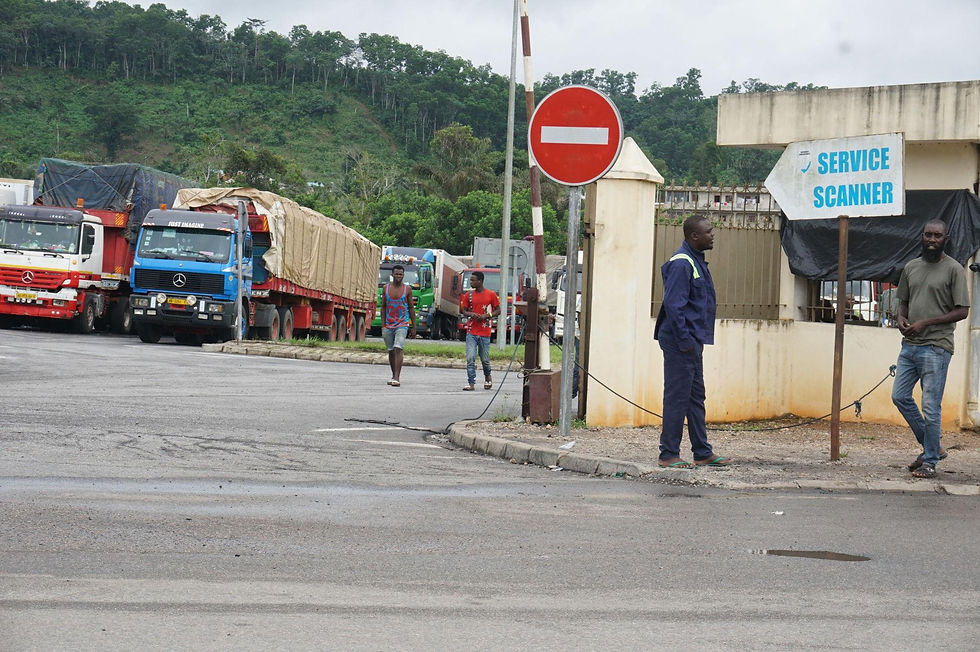
West Africa is fifteen countries. In theory, the African Continental Free Trade Area and ECOWAS agreements should be making cross-border commerce progressively easier. In practice, getting a package from Lagos to Accra, two major commercial cities separated by approximately 500 kilometres, remains a genuinely difficult operation.
Customs clearance processes are inconsistent and time-consuming. Documentation requirements vary and are sometimes applied differently depending on which official you encounter. Border crossings involve multiple stops, each adding time and sometimes informal costs. Clearance timelines are unpredictable in ways that make it impossible to give customers reliable delivery estimates.
The result is that most e-commerce businesses operating in West Africa treat the region as a collection of separate national markets rather than an integrated commercial zone. This limits market size for individual operators, fragments logistics investment across borders rather than concentrating it into more efficient regional networks, and prevents the scale that would improve unit economics across the board.
Fragmentation in West Africa E-Commerce Logistics Challenges

Industry fragmentation remains one of the most complex West Africa e-commerce logistics challenges, with many small operators working independently without standardized system. Unlike the consolidated logistics sectors in more mature markets, West African logistics is dominated by a large number of small, often informal, operators working alongside a smaller number of larger companies, with limited coordination or integration between them.
This fragmentation creates several problems simultaneously. Service quality is inconsistent because the sector lacks a dominant player to set and enforce standards. Integration with e-commerce platforms is difficult because smaller operators lack the technology infrastructure for proper API connectivity. Building reliability at scale is nearly impossible when the delivery network is assembled from dozens of operators with different processes, different technology stacks, and different service standards.
The companies making the most progress, GIG Logistics, Kwik Delivery, Sendbox, and others building serious logistics infrastructure in Nigeria, are doing so by constructing their own networks rather than aggregating existing ones. It is capital-intensive, but it produces more consistent results.
What This Means for Anyone Building in E-Commerce
The challenges described here are not immovable. Infrastructure investment is happening, slowly, but demonstrably. Technology solutions built specifically for African market conditions are improving. Fintech infrastructure is reducing cash-on-delivery dependency. And the commercial incentive to solve these problems is enormous; the market on the other side of reliable, affordable delivery at scale is one of the largest untapped consumer opportunities in the world.
But the businesses that will capture that opportunity are not the ones waiting for infrastructure problems to resolve themselves before building. They are the ones treating logistics capability as a core strategic asset rather than a third-party problem. In a market where delivery quality is rare enough to be genuinely differentiating, the business that consistently gets orders to customers, reliably and on time, holds a competitive advantage that no marketing budget can replicate.
Logistics in West Africa is not just an operational function. It is the business itself. The companies that understand this deeply enough to invest accordingly will define the region's e-commerce landscape for the next decade.


Comments